Developments were started in autumn of 2021. to broaden the application scope of our point-on-wave control function. With nearly two decades of experience in transformer inrush minimizer (TRIM), we set the goal of point-on-wave control of capacitor banks and shunt reactors.
Developments were started in autumn of 2021. to broaden the application scope of our point-on-wave control function. With nearly two decades of experience in transformer inrush minimizer (TRIM), we set the goal of point-on-wave control of capacitor banks and shunt reactors.
Developments were started in autumn of 2021. to broaden the application scope of our point-on-wave control function. With nearly two decades of experience in transformer inrush minimizer (TRIM), we set the goal of point-on-wave control of capacitor banks and shunt reactors.
Developments were started in autumn of 2021. to broaden the application scope of our point-on-wave control function. With nearly two decades of experience in transformer inrush minimizer (TRIM), we set the goal of point-on-wave control of capacitor banks and shunt reactors.
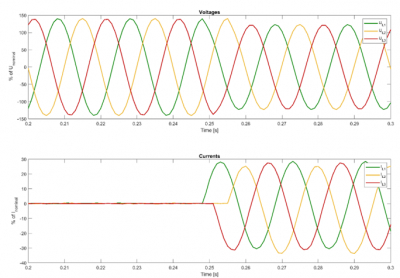
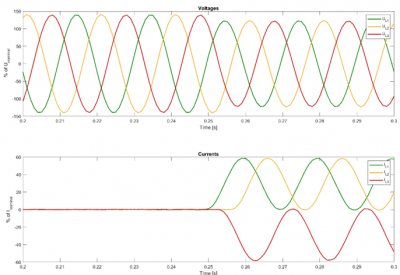
Energizing and de-energizing the different elements of the electrical power system, like transformers, capacitor banks, shunt reactors go always together with the risk of transient overvoltages and overcurrents. The reason lies within the physical characteristics of these equipment: the voltage of a capacitor cannot jump instantaneously, similarly to the flux of a coil. If, however, the energizing voltage forces a jump in these values, that induces transient balancing processes resulting in high inrush currents and overvoltages. These overvoltages and -currents mean heavy stress on the insulations and the mechanical structures of the equipment, causing faster aging of them. Furthermore, they can induce faults and unintended operations of protection devices in the power system. The most efficient handling of these problems is the elimination of the root cause: finding an optimal moment for switching, when the instantaneous value of the energizing voltage or the corresponding flux does not differ from the value measured before the switching. The aim of the controlled switching is to find this moment (point-on-wave) and to delay the energizing accordingly. During de-energizing the aim is to switch off when the current has a zero-crossing, as cutting higher currents results quickly increasing recovery voltage causing overvoltages and restriking.
The different electrical equipment need naturally different energizing strategy mostly because they store the energy in physically different way: in form of charge or of magnetization. The proper energizing strategy is limited by further factors as well: phase-segregated or common drive of the circuit breaker, the system grounding, etc. We took into consideration all these characteristics and factors during the development.
We executed successful tests with real-time simulator for the validation of this control method.
 |
 |
|
|
Energizing a shunt coil in the optimal moment |
Energizing a shunt coil with the worst case angle |

Protecta provides own‑developed protection, automation & control devices for power generation, transmission, distribution, industrial and renewable energy (microgrid) applications.
Késmárk u. 7/A, 1158 Budapest, Hungary +36 1 415 3800 protecta@protecta.hu Protecta LinkedIn

